Skip to navigation menu Skip to main content Skip to footer

Keep up to date on open scholarly communication! Check out what’s new on the blog.

New to preprints and open peer review? Explore our resource library.

Get the latest and greatest preprint and open peer review news in your inbox! Sign up for our newsletter.

Blog Category: ASAPbio news

A survey titled Preprinting early work for community input asks about motivations for receiving feedback, offering options such as journal suggestions, methodological comments, and community engagement. Logos for ASAPbio and ICOR are on the left.

Survey: how early would you preprint and what feedback would you like?

During the pandemic, research communication and progress has accelerated through the massively increased posting of preprints. The increased use of preprints is a positive development, however, most preprints still take the form of traditional research papers posted shortly before or in parallel to their submission to a journal.
Read more
Infographic for ASAPbio Fellows program, featuring five reasons to join: learn about preprints, network, shape initiatives, actualize projects, and build confidence. Includes a link for more info at ASAPbio.org/fellows.

Now open: applications for the 2022 ASAPbio Fellows program

We’re thrilled to open applications for the 2022 ASAPbio Fellows program. Interested in a deep dive into the preprint landscape?
Read more
Matrix of eight icons representing different peer review types. Icons include a review request, reviewer selection, public interaction, author response, decisions, review coverage, reviewer identity, and competing interests marked with text and symbols.

Introducing PReF: Preprint Review Features

This post originally appeared on ReimagineReview. Preprint reviews hold the potential to build trust in preprints and drive innovation in peer review.
Read more
Bar chart titled Services offered by repositories with preprints (n=71). It shows percentages for services: screening (16.44%), DOI assignment (39.73%), versioning support (31.51%), commenting (6.85%), external peer reviews (9.59%), linking to published version (61.64%), and banners (5.48%).

Delving deeper into preprints in institutional and generalist repositories

As open scholarship practices grow, dedicated preprint servers are springing up in many disciplines. However, researchers are also depositing preprints in other platforms, including institutional and generalist repositories.
Read more
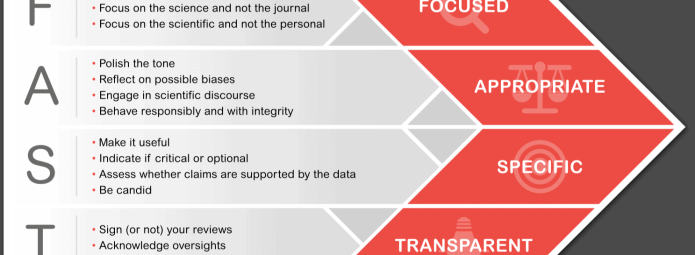
The image is an infographic on improving scientific discourse, using the acronym FAST. It stands for Focused, Appropriate, Specific, and Transparent, with each term describing related actions for effective peer review and communication.

FAST principles for a thriving preprint feedback culture

While preprints have been adopted as a means to promptly disseminate research, they also open up new ways to participate in the scientific discourse around the latest research. There are many benefits to public feedback on preprints: comments that can help authors improve their work, broader opportunities for early career researchers to participate in review, and additional context for readers.
Read more
Crowd preprint review banner - faces of

Experimenting with new modalities of preprint review – what we learnt from the crowd preprint review trial

Traditional peer review relies on a couple of individuals spending hours on a paper. What if the wisdom of the crowd could get it done much faster?
Read more
1 .. 10 11 12 13 14 .. 34