Skip to navigation menu Skip to main content Skip to footer

Keep up to date on open scholarly communication! Check out what’s new on the blog.

New to preprints and open peer review? Explore our resource library.

Get the latest and greatest preprint and open peer review news in your inbox! Sign up for our newsletter.

Blog Category: Preprints

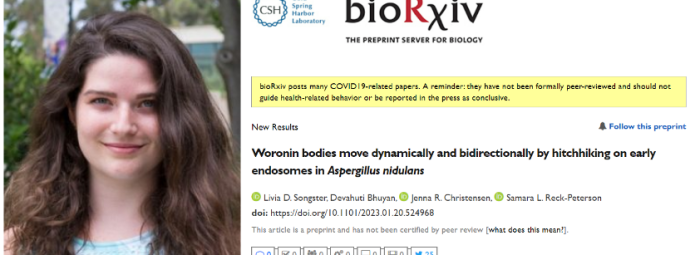
A woman with long, wavy hair smiles at the camera. The text above reads: Cold Spring Harbor Laboratory - bioRxiv with a yellow COVID-19 notice. The article title is about Woronin bodies and endosomes in Aspergillus nidulans.

Sharing negative results via a preprint: A conversation with Livia Songster

This is the third in our series of posts highlighting the winners of the ASAPbio competition ‘Make your negative result a preprint winner,’ which celebrates the value of using preprints to share negative and inconclusive scientific resu... In this post, we hear from Livia Songster (University of California San Diego), the first author of the preprint ‘Woronin bodies move dynamically and bidirectionally by hitchhiking on early endosomes in Aspergillus nidulans‘.
Read more
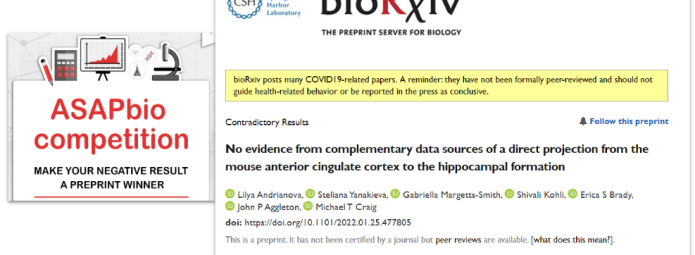
An announcement for the ASAPbio competition encouraging sharing of negative research results. Beside it, a screenshot from bioRxiv mentioning a COVID-19 disclaimer and a study on data sources related to brain function.

Sharing negative results via a preprint: a conversation with Lilya Andrianova

This is the second in our series of posts highlighting the winners of the ASAPbio competition ‘Make your negative result a preprint winner,’ which celebrate the value of using preprints to share negative and inconclusive scientific resu... In this post, we hear from Lilya Andrianova (University of Exeter Medical School & University of Glasgow), the first author of the preprint ‘No evidence from complementary data sources of a direct projection from the mouse anterior cingulate co...
Read more
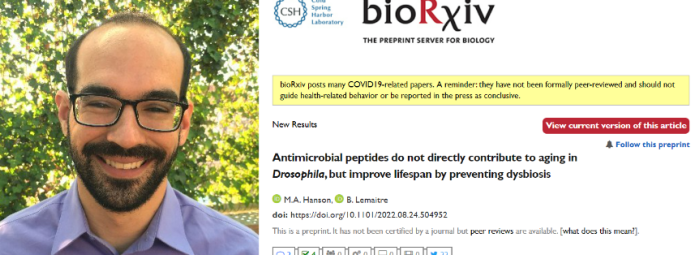
A smiling bearded man with glasses stands outdoors in front of leafy trees. To the right, a screenshot of a bioRxiv research article titled Antimicrobial peptides do not directly contribute to aging in Drosophila, but improve lifespan by preventing dysbiosis.

Sharing negative results via a preprint: A conversation with Mark Hanson

Last week we announced the winners of the ASAPbio competition ‘Make your negative result a preprint winner’, a project by a group of ASAPbio Fellows that aimed to celebrate the value of using preprints to share negative and inconclusive scientifi... We have talked to the authors of the winning preprints to learn more about their work and their motivation to post their results as a preprint.
Read more
midjourney-generated illustration of an open book with flasks and biologically-themed patterns springing from it

ASAPbio’s response to the NIH Plan to Enhance Public Access

Last month, the US NIH released a Request for Information (RFI) for feedback on its planned implementation of last year’s White House Office of Science and Technology Policy (OSTP) directive to make all US federally-funded research immediately publ... Below, we share ASAPbio’s response to the NIH RFI and opportunities for you to get involved in writing your own.
Read more
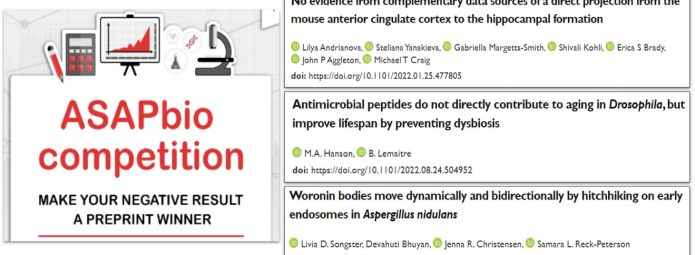
A collage with two sections. Left: ASAPbio competition poster encouraging the submission of negative results as preprints. Right: Titles of scientific articles on brain projections, antimicrobial peptides, and Woronin bodies in various organisms.

Announcing the winners of the ‘Make your negative result a preprint winner’ competition

We are pleased to announce the winners of the ASAPbio competition ‘Make your negative result a preprint winner’, which aimed to highlight the value of sharing negative and inconclusive scientific results via preprints. We know that science advances through a persistent exploration of research questions and approaches, and that this brings with it the fact that some results will not confirm the original hypothesis and that methods will often require troubleshooting.
Read more
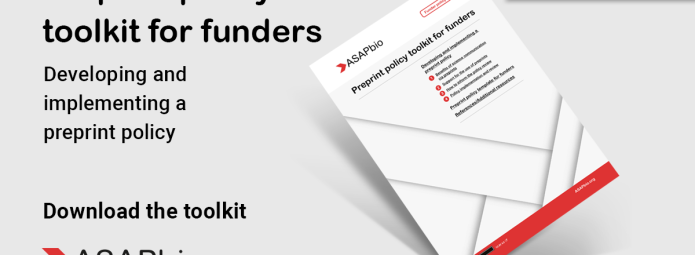
Promotional image for ASAPbios Preprint policy toolkit for funders featuring a brochure cover with text about developing and implementing a preprint policy. It includes a red Download the toolkit button and ASAPbios logo.

ASAPbio preprint policy toolkit for funders

Preprints help to improve the overall quality, integrity and reproducibility of research outputs, as highlighted in UNESCO’s recommendations on open science. Preprint adoption is increasing across scientific disciplines and geographies thanks to the involvement of multiple players, including researchers, publishers, institutions, societies, and funders.
Read more
1 2 3 4 5 .. 22