Keep up to date on open scholarly communication! Check out what’s new on the blog.



Find a Resource
Browse All Resources
Presentation from the “Publish, Review, Curate: Turning scholarly publishing on its head” event at the University of Cambridge – December 3, 2025.
Have you heard the claim, “I’m posting my preprint online, so I don’t need to think about copyright or licensing”? 🤔
In this episode of the ASAPbio Myth Busting Series, we unpack why copyright and licensing still matter when sharing your preprint. From understanding your automatic copyright rights to choosing the right Creative Commons license, we’ll explore how these decisions shape reuse, visibility, and journal publication.
✨ Bottom line: Posting a preprint doesn’t erase copyright—it makes your licensing choices even more important.
Myth: “Preprints are not discoverable or citable.”
Truth: Preprints are an established part of today’s research ecosystem—they have DOIs, appear in major databases, and are recognized by both journals and funders.
In this episode of the ASAPbio Myth Busting Series, we unpack how preprints are indexed, cited, and used across the scientific community. Many reference databases now include preprints; most journals explicitly allow citing them; and funders accept them as evidence of research productivity. Sometimes, preprints can serve as the “director’s cut” of a paper, containing more detail than the final published version and making it the best source to cite.
✨ Takeaway: Preprints are discoverable, citable, and reshaping how we communicate science.
Have you heard the claim: “Posting a preprint will prevent subsequent publication in a peer-reviewed journal.”
🤔 This widespread fear—among early-career researchers—has deep historical roots, but it doesn’t reflect today’s reality. In this episode of the ASAPbio Myth Busting Series, we explore how journal policies have evolved, examine evidence from large-scale studies, and highlight the benefits of preprinting. From rapid dissemination to community input to direct invitation from journals, preprints can expand your reach and strengthen your work.
✨ Bottom line: Posting a preprint does not prevent later journal publication. In fact, it helps speed up discovery, broaden your audience, and make science more open!
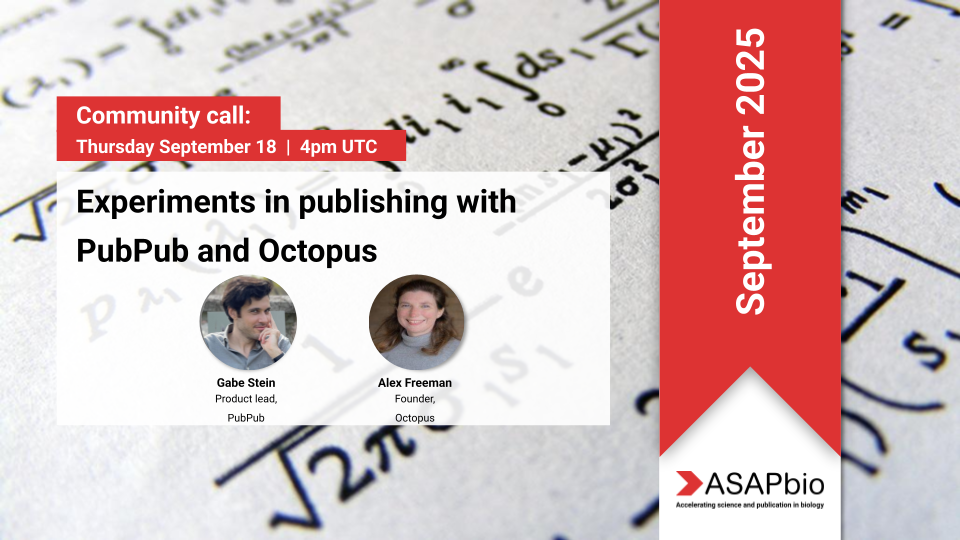
In this month’s community call, we are hosting a panel discussion on various experiments within science publishing. Joining us are Gabe Stein from PubPub and Alex Freeman from Octopus. Each presenter will provide an overview of their experiment and advancements in publishing followed by a Q&A session for attendees to learn more and ask their own questions.
📢 This #PeerReviewWeek, we are tackling a common misconception: “Preprints aren’t peer-reviewed, so they must be poor quality.” Let’s dig into the evidence to show why that’s not true:
✅ Preprints speed up science by making findings freely available to all
✅ Preprint servers often screen for plagiarism, ethical concerns, and scientific scope before posting
✅ Nearly 70% of preprints are later published in peer-reviewed journals—usually with only minor changes
✅ Preprints invite open, community-wide feedback
✅ Peer review is valuable but not perfect, and all research benefits from ongoing scrutiny