Skip to navigation menu Skip to main content Skip to footer

Keep up to date on open scholarly communication! Check out what’s new on the blog.

New to preprints and open peer review? Explore our resource library.

Get the latest and greatest preprint and open peer review news in your inbox! Sign up for our newsletter.

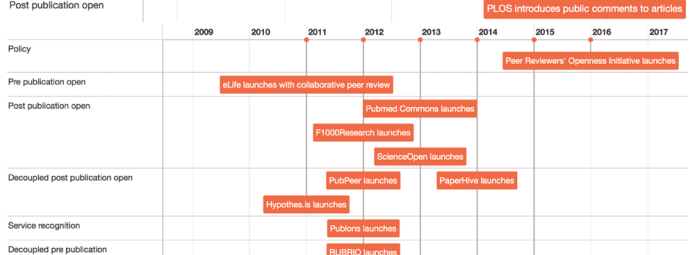
Timeline illustrating the evolution of open peer review from 1990 to after 2020. Key milestones include the launch of arXiv, PLOS ONE, and PubMed Commons, with varying degrees of openness and collaboration listed chronologically.

Six essential reads on peer review

In preparation for our meeting on Transparency, Recognition, and Innovation in Peer Review in the Life Sciences on February 7-9 at HHMI Headquarters, we’ve collected some recent (and not-so-recent) literature on journal peer review. A full annotated bibliography can be found at the bottom of this post, and we invite any additions via comments.
Read more
A logo with the word ASAPbio appears over a background of clear lab test tubes. A red arrow points to the left before the word.

Should reviewers be expected to review supporting datasets and code?

by John Helliwell, Emeritus Professor of Chemistry University of Manchester and DSc Physics University of York (@HelliwellJohn) Introduction For the meeting entitled “Transparency, Reward, and Innovation in Peer Review in the Life Sciences” ... 7-9, 2018 at the Howard Hughes Medical Institute in Chevy Chase, Maryland (https://asapbio.org/peer-review) I have been asked by The Wellcome Trust to open the discussion on the question in my title.
Read more
A logo with the word ASAPbio appears over a background of clear lab test tubes. A red arrow points to the left before the word.

Should scientists receive credit for peer review?

by Stephen Curry, Professor of Structural Biology, Imperial College (@Stephen_Curry) As the song goes – and I have in mind the Beatles’ 1963 cover version of Money (that’s all I want) – “the best things in life are free.” But is peer... The freely given service that many scientists provide as validation and quality control of research papers submitted for publication has its critics.
Read more
A logo with the word ASAPbio appears over a background of clear lab test tubes. A red arrow points to the left before the word.

New directions for ASAPbio: outcomes of the July 19 workshop

On July 19, preprint service providers, funders, and researchers gathered in Cambridge, MA and via videoconference for a live-streamed ASAPbio workshop about the evolving preprint ecosystem (see video recording and collaborative notes). The goal of the meeting was to assess outstanding needs in light of recent developments, including CZI’s partnership with bioRxiv.
Read more
A logo with the word ASAPbio appears over a background of clear lab test tubes. A red arrow points to the left before the word.

ASAPbio newsletter vol 10 – Meeting on 7/19, licensing task force

Dear subscribers, The preprint ecosystem is growing rapidly. The CZI/bioRxiv partnership will fuel the expansion of the leading preprint server in the life sciences, and many other servers and platforms with varying degrees of disciplinary overlap exist or are planned (arXiv, PeerJ Preprints, preprints.org, OS...
Read more
A logo with the word ASAPbio appears over a background of clear lab test tubes. A red arrow points to the left before the word.

ASAPbio launches preprint licensing task force

Every month, more and more life scientists are choosing to post a preprint. This decision can give scientists visibility in their field, establish priority of their work in progress, gain recognition by funding agencies, and elicit feedback to improve their manuscript.
Read more
1 .. 62 63 64 65 66 .. 76