Skip to navigation menu Skip to main content Skip to footer

Keep up to date on open scholarly communication! Check out what’s new on the blog.

New to preprints and open peer review? Explore our resource library.

Get the latest and greatest preprint and open peer review news in your inbox! Sign up for our newsletter.

Blog Category: Events

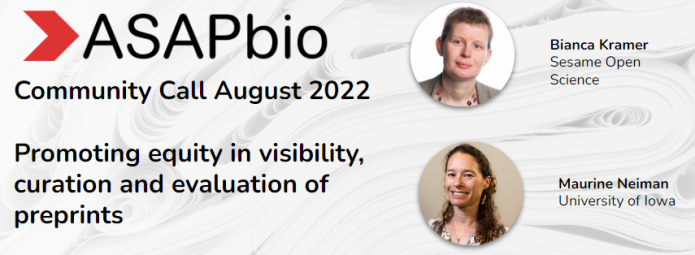
Banner for ASAPbio Community Call August 2022, featuring Bianca Kramer from Sesame Open Science and Maurine Neiman from University of Iowa. Text: Promoting equity in visibility, curation and evaluation of preprints.

How to promote equity in the visibility, curation and evaluation of preprints? – Key takeaways from the ASAPbio Community Call

Whether a preprint will get noticed depends on many factors. Ideally, the quality or the relevance of its scientific findings will be of primary importance, but this is not always the case.  There are many disparities in how preprints (and science in general) get attention.
Read more
Online workshop titled Research assessment and preprints in India. Its for Indian researchers to discuss assessment frameworks and preprints opportunities. Scheduled for Tuesday, June 7, 2022, from 5:00 pm to 6:30 pm IST. Register now.

Research assessment frameworks in India: Assessing the role of preprints

Preprints are increasingly used, but we know that their use varies widely across geographical regions (Abdill et al.). The countries where the use of preprints is most widespread overlap with those where funding organizations and institutions have signaled support for preprints for the dissemination of research works.
Read more
A pile of stickers that say "I review preprints"

ASAPbio preprint commenting coworking sessions

Tuesday, January 11, 2022 – 9am PT, 12pm ET, 5pm UTC (see in your time zone) – Register here Wednesday, January 12, 2022 – 6am PT, 9pm ET, 2pm UTC (see in your time zone) – Register here Feedback on preprints doesn’t have to take the shape ... Short comments or questions can also be very useful to readers, authors, and journals looking for reviewers and editors.
Read more
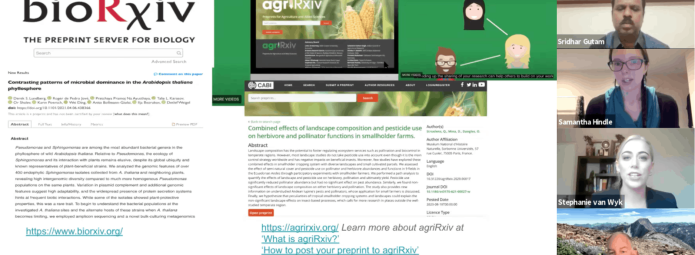
Screenshot of a digital presentation featuring screenshots of websites, thumbnails of people in video calls, and logos of bioRxiv and agriRxiv. Text includes links and information about submitting preprints related to biology and agriculture.

Preprints in plant sciences and agriculture – webinar recap

The use of preprints is growing across different life sciences disciplines. After a slower adoption in the plant and agricultural sciences, we are now seeing more researchers in these fields disseminating their work via preprints.
Read more
A signpost with three arrows pointing in different directions labeled Past, Present, and Future. Below them, a rectangular sign labeled Preprints with a document icon. The arrows have red tips.

Panel Discussion: The past, the present and the future of preprints

Scientific manuscripts often spend months, sometimes years, in the hands of a restricted number of reviewers and editors before they are ultimately released to the rest of the scientific community after peer review. In recent years, the growing usage of preprints in the life sciences has revolutionized the publishing system by allowing the separation of the communication of scientific discoveries from their assessment by scientists, editors and journals.
Read more
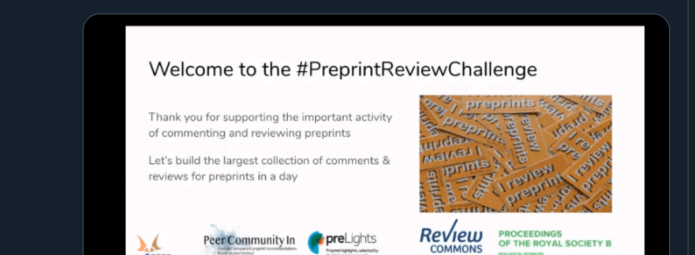
A tweet from ASAPbio announcing the #PreprintReviewChallenge with a digital poster on reviewing preprints. Logos of associated organizations are at the bottom. The date, September 22, is mentioned in the tweet.

#PreprintReviewChallenge – Reviewing preprints together

Earlier this week we hosted the #PreprintReviewChallenge, a collaborative session where we worked on comments and reviews of preprints. The event was part of Peer Review Week and our goal was to develop the largest collection of public reviews on preprinted research in a day, and of course, also to connect with others with an interest in this important activity.
Read more