Skip to navigation menu Skip to main content Skip to footer

Keep up to date on open scholarly communication! Check out what’s new on the blog.

New to preprints and open peer review? Explore our resource library.

Get the latest and greatest preprint and open peer review news in your inbox! Sign up for our newsletter.

Blog Category: Preprints

A logo with the word ASAPbio appears over a background of clear lab test tubes. A red arrow points to the left before the word.

Surveying the landscape of products and services for sharing preprints

The available products and services include several open-source options with paid or free services and/or as free software. For example, the Center for Open Science now lists 22 individual preprint servers powered by the open-source OSF Preprints platform, including EcoEvorXiv (ecology, evolution and conservation), FocUS Archive (focused ultrasound research), MarXiv (ocea...
Read more
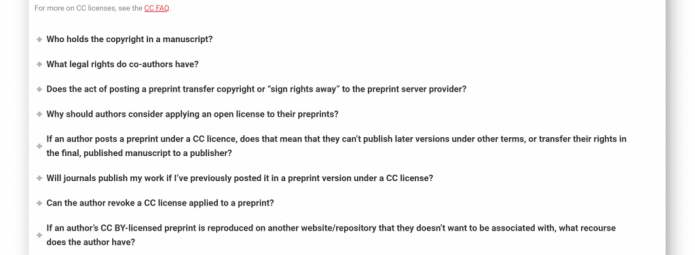
Screenshot of the ASAPbio website displaying a section titled Copyright and CC license basics. It contains a list of FAQs related to copyright, posting rights, preprints, and Creative Commons licenses.

Sharing new educational resources on open licensing for preprints

By Jessica Polka (ASAPbio), Donna Okubo (PLOS), and Tim Vollmer (Creative Commons) Today we’re happy to share two new documents that we hope will aid researchers in their decision to share early work as preprints. Even while the practice of publishing preprints continues to grow, we know from our community outreach that there are still lots of questions regarding open licensing options, including downstream publishing implications for preprints.
Read more
A logo with the word ASAPbio appears over a background of clear lab test tubes. A red arrow points to the left before the word.

Responding to concerns about preprints in the media

A July 24 article by Tom Sheldon of the Science Media Centre raised concerns about the use of preprints in the media. Soon after, nine eLife ambassadors (some of which are also ASAPbio ambassadors) responded in a preprint entitled “Maintaining confidence in the reporting of scientific outputs.” Many of the same sentiments are echoed the following response.
Read more
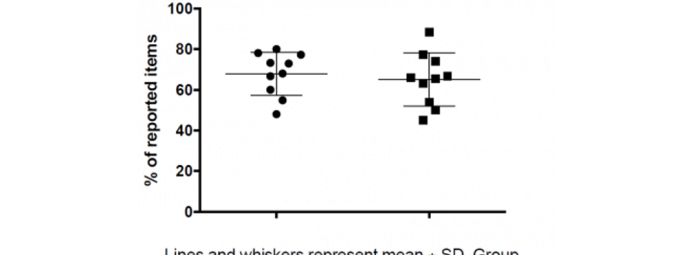
Scatter plot showing the average reporting quality of preprints versus peer-reviewed articles. Two columns of data points with error bars represent mean ± SD. One column is from bioRxiv and the other from PubMed, with percentages on the y-axis.

Comparing quality of reporting between preprints and peer-reviewed articles – a crowdsourced initiative

By Olavo B. Amaral Institute of Medical Biochemistry, Federal University of Rio de Janeiro, Brazil As the preprint movement gains traction in biology, the time is ripe to revisit some aspects of scientific publication that we view as fundamental – first and fo...
Read more
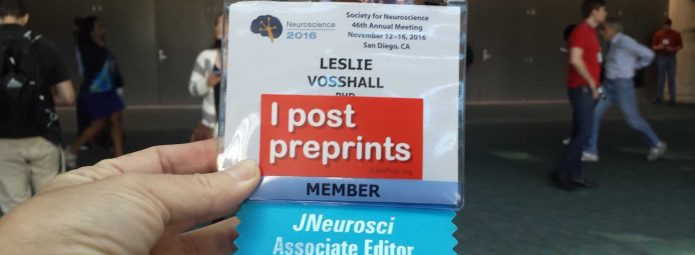
A person holds a name badge from the Society for Neuroscience 2016 Annual Meeting in San Diego. The badge displays the name Leslie Vosshall with a red sticker saying I post preprints and has a blue ribbon labeled JNeurosci Associate Editor.

10 ways to support preprints (besides posting one)

Preprinting in biology is gaining steam, but the process is still far from normal: the upload rate to all preprint servers is about 1% that of PubMed. The most obvious way for individual scientists to help turn the tide is, of course, to preprint their own work.
Read more
A logo with the word ASAPbio appears over a background of clear lab test tubes. A red arrow points to the left before the word.

Some thoughts on ASAPbio

Angela DePace, Assistant Professor, Department of Systems Biology, Harvard Medical School I believe strongly in open access (mainly because everyone deserves access to the scientific literature, but also because of the immorality of making ...  I also believe in open peer review; I strive to write critiques that I would be happy to read to the author in person.
Read more