Skip to navigation menu Skip to main content Skip to footer

Keep up to date on open scholarly communication! Check out what’s new on the blog.

New to preprints and open peer review? Explore our resource library.

Get the latest and greatest preprint and open peer review news in your inbox! Sign up for our newsletter.

Blog Category: Peer review

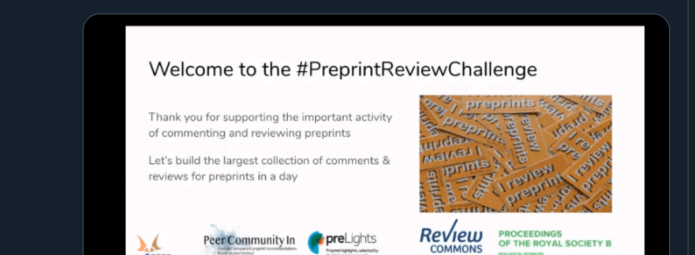
A tweet from ASAPbio announcing the #PreprintReviewChallenge with a digital poster on reviewing preprints. Logos of associated organizations are at the bottom. The date, September 22, is mentioned in the tweet.

#PreprintReviewChallenge – Reviewing preprints together

Earlier this week we hosted the #PreprintReviewChallenge, a collaborative session where we worked on comments and reviews of preprints. The event was part of Peer Review Week and our goal was to develop the largest collection of public reviews on preprinted research in a day, and of course, also to connect with others with an interest in this important activity.
Read more
Illustration of a person holding a magnifying glass, focusing on their eye. The background features large, stylized pages of a book with green and gray colors.

Systematize information on journal policies and practices – A call to action

By Willem Halffman, Serge Horbach, Jessica Polka, Tony Ross-Hellauer, and Ludo Waltman Crossposted from Leiden Madtrics Recently the creators of Transpose and the Platform for Responsible Editorial Policies convened an online workshop on infrastructu... In this blog post they look back at the workshop and discuss next steps.
Read more
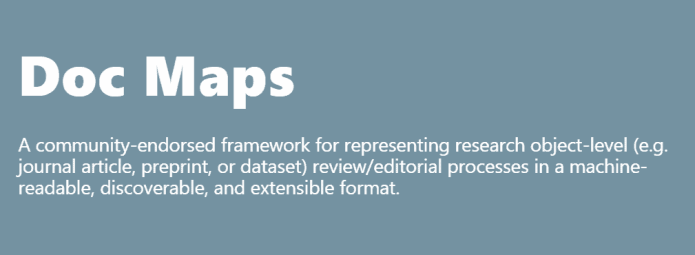
A blue background features white text: Doc Maps in large font. Below, smaller text reads: A community-endorsed framework for representing research object-level (e.g. journal article, preprint, or dataset) review/editorial processes in a machine-readable, discoverable, and extensible format.

Announcing Doc Maps: a framework for describing editorial events

Today, we’re happy to announce a collaboration with TU Graz and the Knowledge Futures group on Doc Maps, a project to create machine-readable ways to describe peer review & editorial processes on articles. As preprints undergo screening checks and pick up peer review from an increasing number of third party sources, it’s becoming more challenging to know to what extent they have been scrutinized (and what that process looks like).
Read more
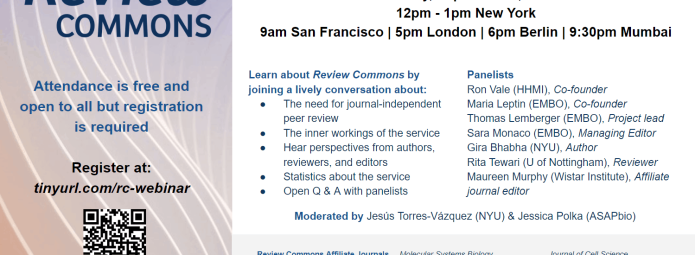
Promotional poster for the Journal-independent Peer Review in the Life Sciences webinar on September 8, 2020. Features panelist names, topics to be discussed, and sponsors, with registration info at tinyurl.com/rc-webinar.

Review Commons webinar: Journal-independent Peer Review in the Life Sciences

Tuesday, September 8, 2020  12pm New York | 9am San Francisco | 5pm London | 6pm Berlin | 9:30pm Mumbai About half of biomedical articles are submitted to more than one journal, leading to repeated peer review and publication delays. Review Commons is a free, journal-independent peer review service that allows you to transfer your manuscript and its reviews to one of 17 participating journals for consideration, and to post your refereed preprint to bioRxiv.
Read more
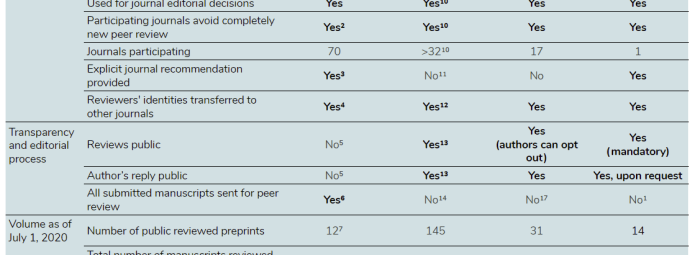
A table comparing journal peer review services, detailing aspects like journal interactions, transparency, community involvement, and volume as of July 1, 2020. Columns include specifics such as peer review, recommendation, and submission metrics.

Comparing journal-independent review services

Preprinting not only accelerates the dissemination of science, but also enables early feedback from a broad community. Therefore, it’s no surprise that there are many innovative projects offering feedback, commentary, and peer reviews on preprints.
Read more
A person in business attire sits cross-legged, holding a tablet. The screen displays colorful charts and graphs. The person is using a stylus to interact with the tablet. The setting appears to be a casual office.

Improving peer review through research

By Victoria Yan This post originally appeared at ReimagineReview, a registry of innovative peer review projects. Here on ReimagineReview, we envision the constant improvement of peer review through experimentation and research.
Read more
1 2 3 4 5 .. 9