Skip to navigation menu Skip to main content Skip to footer

Keep up to date on open scholarly communication! Check out what’s new on the blog.

New to preprints and open peer review? Explore our resource library.

Get the latest and greatest preprint and open peer review news in your inbox! Sign up for our newsletter.

Blog Category: Peer review

A collection of vintage glass bottles, in varying shades of purple, are clustered together. The bottles differ in shape and size, with some having narrow necks and others with wider openings, set against a softly lit background.

ReimagineReview community call: Revealing quality in peer review through increased transparency

September 20, 9am PDT, 12pm EDT, 6pm CEST The theme of this year’s Peer Review Week, “quality in peer review,” should resonate with anyone—author, referee, or reader—invested in the process of formal publication. But how can those without a direct window into the peer review process be assured of its quality, both the entire body of peer review that a journal or project organizes, and more specifically the reviews covering an individual article?
Read more
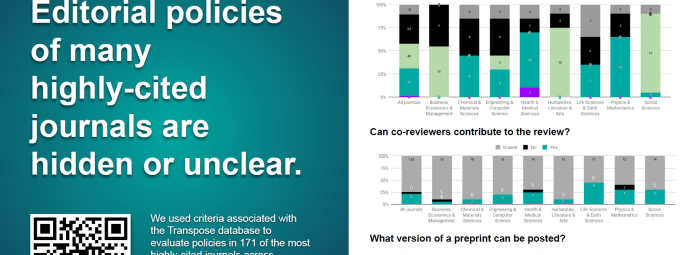
A poster showing that the editorial policies of many highly-cited journals are hidden or unclear

Many highly-cited journals have unclear preprint & peer review policies

Over the last year, the Transpose team (which includes ASAPbio staff Naomi Penfold and Jessica Polka and board member Jennifer Lin) have been working to produce a database of journal peer review, co-reviewing, and (detailed) preprint policies. We anticipate the launch of this database along with an interactive website in the coming weeks.
Read more
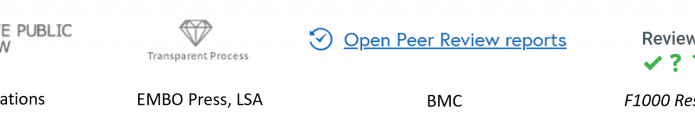
Logos and names of publishing platforms: Interactive Public Peer Review, Transparent Process, Open Peer Review reports, Reviewer Status. Below are publisher names: Copernicus Publications, EMBO Press, LSA, BMC, F1000 Research & family.

Making peer review reports visible

Publishing peer review reports has many benefits, but critics often worry that it’s unlikely to be read or seen. This isn’t true: data suggest that peer review reports can receive 10% or ⅓ of the traffic to the article itself.
Read more
A crowded subway platform with a diverse group of people waiting. Many are holding or looking at their phones. The platform is dimly lit, and a track is visible in the foreground. The atmosphere is busy and typical of a city commute.

Technological Support for Peer Review Innovations

This post originally appeared on The Scholarly Kitchen on 2019-03-26. Cover image via Eddi Aguirre.
Read more
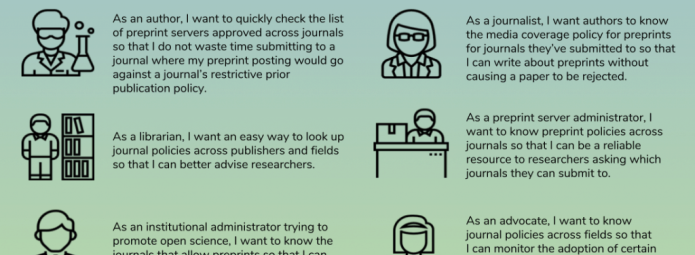
Infographic titled Who needs a database of detailed preprint policies? with icons and text explaining the needs of authors, journalists, librarians, administrators, and advocates for easy access to journal preprint policies.

Just published: examining the breadth of journal preprint policies in TRANSPOSE

Those who have been following ASAPbio for a while know that journal policies on preprinting are always in flux. As adoption of preprints—and editors’ comfort with them—increase, these changes are typically positive.
Read more
Screenshot of the ReimagineReview website. It describes the platform as a registry for peer review experiments. A call to action invites users to add listings. The header includes links to about, glossary, calendar, and blog sections.

Launching ReimagineReview, a registry of peer review experiments

Today, we’re excited to announce the launch of ReimagineReview, a registry of platforms and experiments innovating around peer review. We now have the technology to experiment with peer review and research evaluation in ways that were not possible decades ago.
Read more
1 .. 3 4 5 6 7 .. 9