Skip to navigation menu Skip to main content Skip to footer

Keep up to date on open scholarly communication! Check out what’s new on the blog.

New to preprints and open peer review? Explore our resource library.

Get the latest and greatest preprint and open peer review news in your inbox! Sign up for our newsletter.

Blog Category: Peer review

A logo with the word ASAPbio appears over a background of clear lab test tubes. A red arrow points to the left before the word.

Advancing peer review

By Elizabeth Moylan, Senior Editor, Peer Review & Innovation, BMC (part of Springer Nature) At BMC, we’ve always supported innovation in peer review and were one of the first publishers to truly open up peer review in 1999. Fiona Godlee, then Editorial Director for BMC, explained the reasons for this decision, including ethical superiority (reviewers are accountable for their decisions and there is less scope for biased or unjustified judgements or misappropriate of dat...
Read more
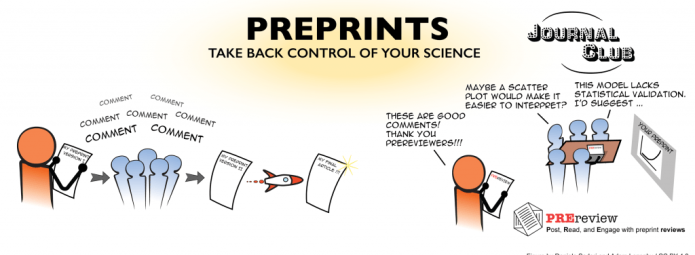
A comic showing a researcher receiving papers with comments and feedback from a preprint service. They present the work to a journal club. Text bubbles: These are good comments! and This model lacks statistical validation. At the bottom: PREreview logo.

Preprint Journal Clubs: building a community of PREreviewers

By Samantha Hindle and Daniela Saderi, PREreview The image above (DOI)  is CC-BY 4.0 licensed and is available for download on Figshare. Preprints are freely available scientific manuscripts that have not yet undergone editorial peer review.
Read more
A logo with the word ASAPbio appears over a background of clear lab test tubes. A red arrow points to the left before the word.

On the Need for Editorial Standards

By Damian Pattinson, Research Square Introduction The term ‘peer review’ has come to mean any assessment performed on a manuscript prior to publication. So for any paper submitted to a journal, it ‘undergoes peer review’ and it is published.
Read more
A logo with the word ASAPbio appears over a background of clear lab test tubes. A red arrow points to the left before the word.

New Forum for Peer Reviewed Research in the Biomedical Sciences

By Harinder Singh, Division of Immunobiology and the Center for Systems Immunology, Cincinnati Children’s Hospital Medical Center Motivation Although major research advances are rapidly being made in the biological and biomedical sciences, the comm... Despite the large and expanding number of journals, there are considerable limitations, including the cumbersome nature of the process.
Read more
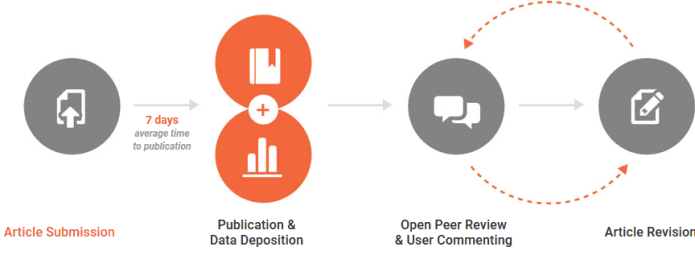
Flowchart showing article publication process: Submission, 7 days to Publication & Data Deposition, followed by Open Peer Review & User Commenting, ending with Article Revision. Arrows indicate the sequence, and dotted lines suggest iterative revisions.

F1000: our experiences with preprints followed by formal post-publication peer review

By Rebecca Lawrence & Vitek Tracz, F1000, [email protected] We have been successfully running a service (which we call platforms, to distinguish from traditional research journals), for over 5 years at F1000 that is essentially a preprin... not crowd-sourced) post publication peer review.
Read more
A dimly lit room with a single wooden door slightly ajar. Light seeps through the opening, casting a narrow beam on the floor. The surrounding area remains in shadow, creating a contrast between the illuminated doorway and dark interior.

It’s time to open the black box of peer review

By Jessica Polka and Ron Vale, ASAPbio Opening the content of peer review reports—whether they are anonymous or not—will improve their quality, ensure that ideas that emerge through review are accessible to other researchers, and enable innovatio... Peer review is considered an essential standard of scientific publishing.
Read more
1 .. 5 6 7 8 9